
Young County Court Record Requests
Which clerk you call on depends on the court. The District Clerk handles 90th Judicial District Court civil, family, felony, and juvenile files. The County Clerk handles Young County Court misdemeanors, probate, and the county-level civil records that office identifies. JP clerks keep their own justice and traffic files. Each municipal court holds its citations and ordinance cases.
The internet is only one channel. The District Clerk takes counter, phone, email, fax, and mail requests. The County Clerk offers the same office channels plus links to online public records and criminal, civil, and probate records. re:SearchTX adds a statewide discovery layer on top. Rule 12 covers a request for a judicial administrative record, but a copy from a case file starts with the clerk.
- Identify the court and the clerk that holds the case.
- Locate the cause number through the Young County docket search routes if needed.
- Name the docket sheet, pleading, order, judgment, exhibit, or probate filing wanted.
- Choose plain paper, electronic, or certified copies and state the quantity.
- Ask about search charges, prepayment, identification, delivery, and current timing.
- Send the request by the channel that clerk confirms.
Four Young County Record Layers
Think of Young County records in four layers. The calendar tells you what is scheduled. The docket, or register, tells you what event the clerk recorded. A filed-document image gives you the actual words of a petition, motion, order, or judgment. A certified copy adds the clerk's authentication. Getting one layer does not guarantee access to the next.
| Layer | Main question | Likely route |
|---|---|---|
| Calendar | What is set? | County calendar or court notice |
| Docket/register | What events were entered? | Clerk or case portal |
| Filed document | What does the paper say? | Clerk image or copy request |
| Certified copy | What copy is authenticated? | Holding clerk |
A case caption and a status line can still leave you without the signed order. That order is what explains the outcome. When a register entry is unclear, ask for the order by its date and title.
Kinds of Young County Court Records
What you can get depends on the court and its access rules. A clerk's file may hold a docket sheet, the initiating paper, a service return, an answer, motions, notices of setting, orders, a final judgment, a bond record, or an appeal notice. Probate files add applications and orders. Traffic files may hold a citation, a plea, payment records, a driving-safety request, a deferred-disposition event, or a judgment.
- Docket sheets and case registers
- Petitions, complaints, informations, and indictments
- Motions, responses, notices, and service returns
- Signed orders, judgments, and decrees
- Probate and guardianship filings when public
- Traffic and lower-court case papers
Exhibits and protected personal details often carry tighter access rules. When a file is large, ask for a specific item rather than "everything."
Room 201 or Room 104
Both main clerk counters sit inside the Young County Courthouse. The address is 516 Fourth Street in Graham. Stacey Beller Mallory serves as District Clerk, with her office in Room 201. Call 940-549-0029, fax 940-549-4874, or email districtclerk@youngcounty.org for district court records and docket help. Tina Gilliam holds the County Clerk post for Young County in Room 104. She is reachable at 940-549-8432, fax 940-521-0305, or countyclerk@youngcounty.org.
Young County Clerk Counters
District records: Room 201
County and probate records: Room 104
516 Fourth Street, Graham, TX 76450
District: 940-549-0029
County: 940-549-8432
Hours differ between the two offices. The District Clerk posts split weekday hours, closes at noon, and closes earlier on Friday. The County Clerk posts weekday morning and afternoon hours. Call ahead for a large file or a certified copy, since neither office guarantees a turnaround or a public terminal.
Young County Records: What They Contain
A court file and its docket share the same key identifiers. Each document adds detail. The cause number ties them together. Read status terms alongside the latest event and the signed order. "Disposed" marks a closed record state, yet it does not explain the ruling by itself.
| Cause number | The unique court and clerk identifier. |
|---|---|
| Case style | The short caption naming the parties. |
| Court and type | The assigned court and civil, family, criminal, probate, traffic, or other category. |
| Filing date | When the initiating paper entered the clerk system. |
| Event history | Service, motions, settings, resets, orders, and disposition. |
| Document text | The substance of the filed pleading, order, or judgment. |
| Access marker | Public, redacted, sealed, confidential, or otherwise restricted. |
Young County Requests Without Forms
Young County offers no generic certified-copy web form and no countywide case-file request form. A written request can still be precise. List your contact method, the court, the cause number, the case style, the exact document, the date range, the copy type, the quantity, and how you want it delivered. Ask before sending money whether the office needs identification, a self-addressed envelope, or prepayment.
Phone and email work well for confirming custody and charges. Fax or mail preserves the exact wording of your request. The counter is best when you know the file and staff confirms it is ready. No Young County clerk promises same-day service or a set turnaround, so confirm timing directly.
Copy Fees and Certification
The District Clerk's schedule, effective September 1, 2025, lists separate search, reproduction, and certification charges. The County Clerk page states a different amount for an open-public-record document and limits the stated payment methods. These schedules come from different offices. Do not blend them.
| Item | Amount | Source or limit |
|---|---|---|
| Name search | $5 per name | District Clerk schedule |
| Printed copy | $1 per page | District Clerk schedule |
| Electronic copy | $0.10 per page, $1 minimum | District Clerk schedule |
| Certification | $5 | District Clerk schedule, plus copy charges |
| Open-public-record document | $25 first page; $4 each added page | County Clerk statement; confirm record type |
The County Clerk requires a cashier's check or money order and accepts no out-of-state checks. Vendor or image charges are not listed. Confirm the total before you order.
eFileTexas and Young County Records
eFileTexas is mainly a filing route, not a public archive. A submission, the clerk's acceptance, a docket entry, and a public image can appear at different times. Access can differ for each. An e-filing receipt proves a transmission event, nothing more. It is not a certified copy of the filed document or the complete docket.
Attorneys must e-file in the covered Texas courts described by the state system. That spans civil, family, probate, criminal, appellate, district, and county courts. Non-attorneys are encouraged to use it, and some JP courts permit e-filing. For a public copy, go back to the Young County office that maintains the case. Do not assume the filing account holds everything.
Access Rules for Court Records
Court files in Texas sit outside the usual public-records statute. Government Code §552.0035 hands judicial information over to Supreme Court rules. Whatever other law applies still counts. Rule 12 is the one that matters for judicial administrative records. It builds a written process: request, denial, and review. It was never meant to replace a simple counter request for a copy of a case file, though. For Young County court docket copies, the clerk is the better first stop. The official Young County Clerk page names the county-record counter along with its online record routes.
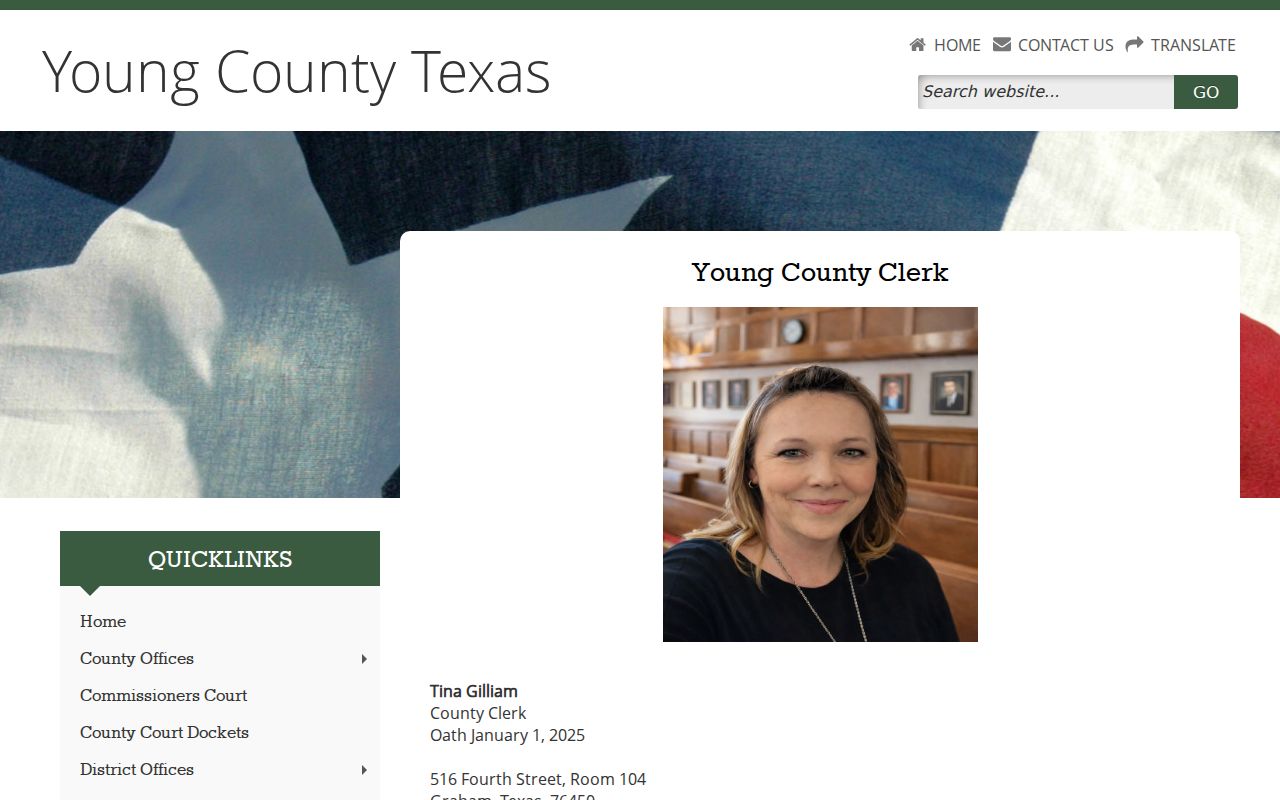
That clerk page also sorts out where requests belong. County misdemeanor and probate filings go to Room 104, not the District Clerk counter.
Public access: Rule 76a addresses sealing of civil court records, while Texas Family Code Chapter 58 restricts juvenile material. A certification does not make a sealed record public.
Old Young County Court Records
A modern portal will not always reach old paper or microfilm. Young County has had courthouses in 1876, 1884, and the present building from 1932. So older records live in many places. The Texas State Library and Archives Commission holds Young County local-record microfilm. It warns that some years are missing, repeated, or incomplete.
Start with the current clerk, since custody and indexes may have shifted over time. When you ask, give the record series, the court, an approximate year, and the cause number. If the clerk points you to an archive, follow that lead. A blank online result is not proof that an old Young County case never existed.
Note: Historic research works best with a court name, date range, party spelling variants, and any known cause number.