
Young County Civil Docket Searches
The main district civil route starts with the Young County District Clerk and re:SearchTX. Search by cause number when possible. If only a party name is known, the statewide guide documents an Advanced control and wildcard support for party names. Match the court, case type, parties, and filing date before relying on a result.
The County Clerk advertises a separate criminal, civil, and probate online-records route through TexasOnlineRecords, but the anonymous screen begins with login fields. Its scope should be confirmed with that office. The Official Records Search uses grantor, grantee, subdivision, document type, document number, date, and OCR fields, which do not establish that it is a complete district civil register.
- Identify the court and copy the cause number from a notice, pleading, or order.
- Use re:SearchTX for district metadata or the clerk-linked route for confirmed county coverage.
- Match the court, parties, case type, and filing date.
- Read the register in date order, including motions, settings, orders, and disposition.
- Ask the responsible clerk for a plain, electronic, or certified document when needed.
The 90th District Civil Route
The 90th Judicial District Court is Young County's main district civil and family court. Stacey Beller Mallory's District Clerk office processes those case files and supplies public copies. The local rules describe one combined criminal and civil docket as extremely heavy and place all settings under the court coordinator.
The official District Clerk source shows the local forms, rules, e-filing, and records routes used for Young County civil court dockets.
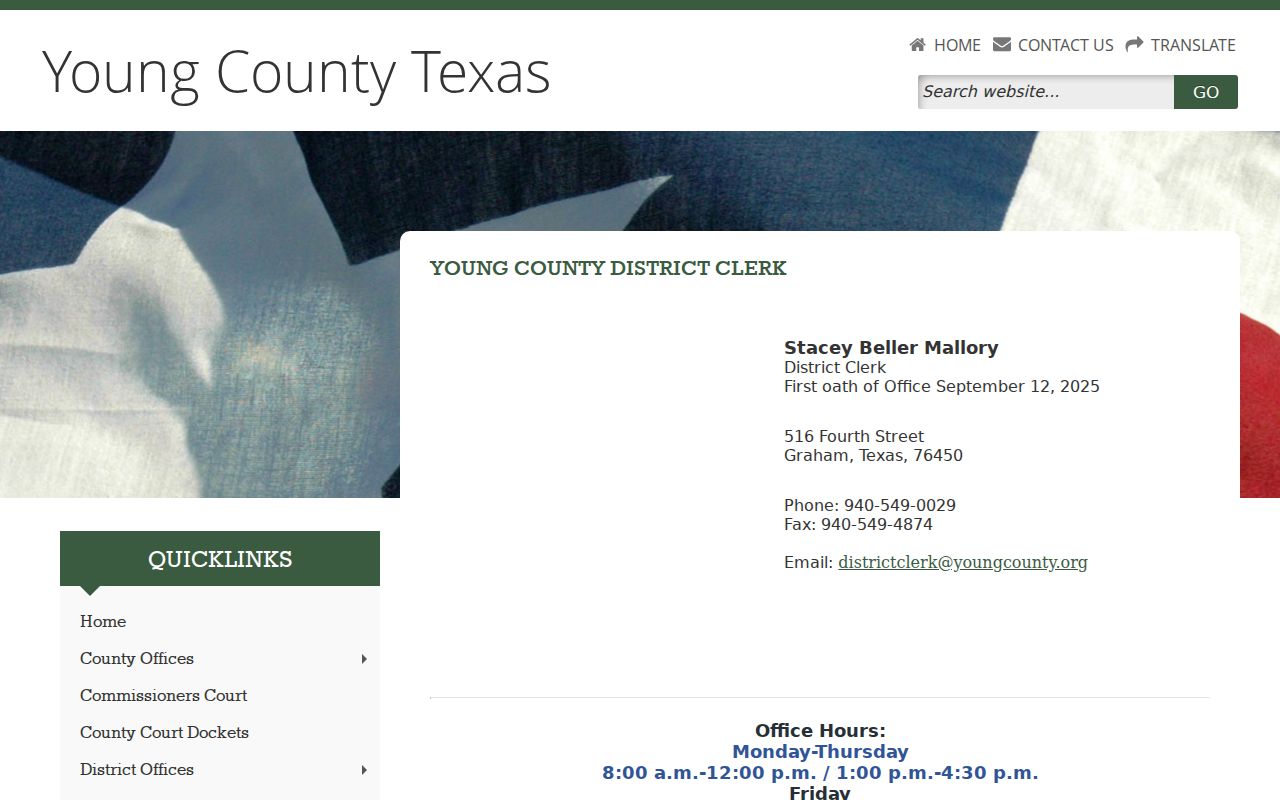
The image anchors the search to the office that keeps district civil files rather than to a broad official-records index.
Civil Dockets: What They Show
A Young County civil docket records procedural events. A petition begins many cases, followed by citation and service, an answer, motions, conference certificates, settings, mediation, orders, and a judgment or other disposition. A public entry can name a document without making its image free or public. Exact Young County case-number and code formats were not published, so unfamiliar abbreviations should be checked with the clerk.
| Cause number | The clerk's case identifier and the best search key. |
|---|---|
| Parties and counsel | Plaintiff and defendant or petitioner and respondent, plus attorneys when public. |
| Register events | Petition, citation, service, answer, motion, conference certificate, notice, and order. |
| Settings | Hearing, docket call, mediation, trial, reset, or continuance information when available. |
| Disposition | Judgment, dismissal for want of prosecution, nonsuit, transfer, settlement, or another final event. |
A Filed Motion Is Not Granted
A motion entry proves that the clerk recorded a request. It does not show that the judge approved it. Look later in the Young County civil docket for an order, hearing result, or final judgment. The same caution applies to mediation and settlement references. A setting can show that an issue was due to be heard, but only the later record shows what occurred.
The local rules require counsel to confer before most motions and file a certificate stating the dates, actions, and method of conferring. Exceptions include dismissal of an indictment, suppression, summary judgment, and new-trial motions. This local step can explain why a conference certificate appears beside a motion.
What Cases Fill the Civil Docket
The District Clerk fee schedule supplies useful local search terms without deciding any case's merits. Young County district categories include non-family civil suits, tax suits, divorce, protective orders, adoption, name changes, transferred or severed cases, and foreign judgments. Other pleadings include counterclaims, interventions, third-party petitions, enforcement, contempt, modification, and new-trial motions.
- Non-family civil and tax matters in district court
- Divorce and other family proceedings
- Protective orders, adoption, and name-change matters
- Transferred, severed, and foreign-judgment matters
- Small civil, eviction, and debt claims assigned to JP courts
Probate belongs to the constitutional County Court and County Clerk. Small civil matters belong to the assigned JP. A broad civil label is therefore not enough to choose the right Young County clerk.
Young County Civil Filing Costs
The District Clerk schedule effective September 1, 2025 lists $350 for many original-petition categories and $80 for several later or additional pleadings. Those are filing charges, not fees for viewing a docket. It separately lists a $5 name search, $1 per printed page, $0.10 per electronic page with a $1 minimum, and $5 certification.
| Item | Published amount | Meaning |
|---|---|---|
| Original petition category | $350 | Filing charge |
| Other listed pleading | $80 | Filing charge |
| Name search | $5 per name | Clerk search |
| Printed or electronic copy | $1 page or $0.10 page, $1 minimum | District Clerk copy |
| Certification | $5 | Authentication added to copy charges |
Confirm the current total before sending payment. The County Clerk publishes a different schedule, so the two offices' amounts must not be blended.
Hearings on the Civil Docket
All 90th District settings are scheduled through the coordinator. Counsel should discuss proposed dates in advance, and confirmation emails must copy all parties. The court may set its own dates, and counsel must be ready when called. The Young County court schedule covers calendar checks and moved dates, but the coordinator's confirmation and signed orders carry more weight than a stale view.
Mediation is required before a jury trial on the merits and is discretionary in nonjury matters. Temporary matters have local time limits, and the rules direct participants to arrive at least 30 minutes early to attempt settlement. These steps can produce several procedural entries before trial.
Young County's 180-Day DWOP Rule
DWOP means dismissal for want of prosecution. Young County's local rule permits a case with no activity for 180 days to be placed on a notice or dismissal docket. A party may need a written motion to retain the case or remove it from that list. The appearance of a DWOP notice is not the same as a final dismissal.
Read the next entry for an order, retention, reset, or dismissal. If the register seems incomplete, ask the District Clerk for the relevant notice and signed order. Do not infer that a case ended from age alone.
Young County Civil Caseload Context
OCA's FY 2024 district report lists 264 active pending civil cases at the start, 184 added, 172 disposed, and 274 active pending at year end. Family activity appears in a separate row, so this is not the whole district workload. These are aggregate fields, not search results.
The figures cannot identify a party, result, delay, or next setting.
Who Can See Civil Dockets
Texas civil court records begin with a presumption of openness, but online access is not guaranteed. Sealing orders, protective orders, family confidentiality, juvenile law, and redaction rules can limit an entry or image. Unfiled discovery is not necessarily part of the court record. A missing image may also reflect portal coverage or a purchase requirement rather than sealing.
Key rules:
Texas Rule of Civil Procedure 76a sets the presumption and findings required to seal civil court records.
Texas Government Code §552.0035 says judiciary information follows court rules and other applicable law.
Texas Family Code Chapter 58 restricts juvenile records and information.
Ask the District Clerk for a specific public pleading, order, judgment, or certified copy. A certification authenticates what the clerk releases; it does not override a restriction.
A useful request names the Young County court, cause number, case style, exact pleading or order, date range, copy format, and delivery preference. Ask whether a search fee, prepayment, identification, or return envelope is required. The reviewed office pages do not promise a standard turnaround or same-day certification. A request for a case-file copy normally goes to the clerk, while a written Rule 12 request concerns defined judicial administrative records. Keeping those paths separate prevents delay and helps the custodian identify the civil record that is actually sought.